| Title of artwork |
|
| Date of work |
|
| Artist(s) |
|
| Locations |
|
| Narrative |
|
| Collected in ... |
|
| Detail pointer |
|
| Description |
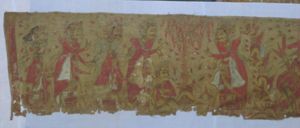
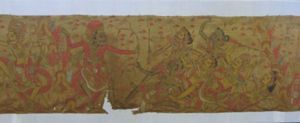
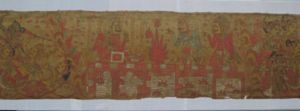
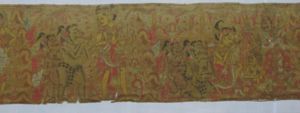
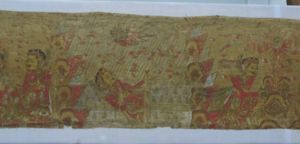
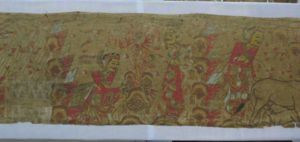
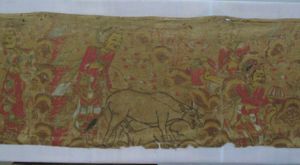
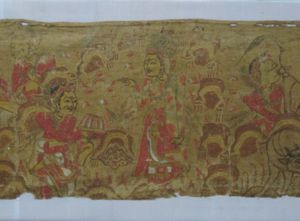
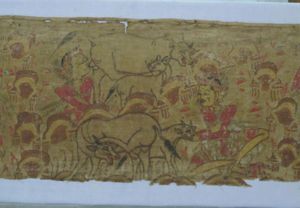
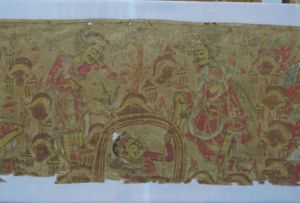
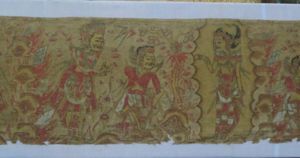
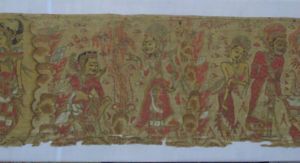
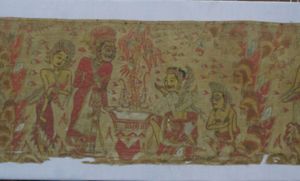
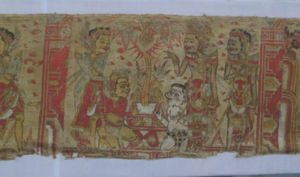
Begins with the killing of Rama Parasu, and continues with the story of Janamejaya. There is a join connecting the story of Bagawan Uttangka, which may have been a separate painting
|
| Abstracted summary |
There is a date on the back of this painting, saka 1844=1919. Although the attribution is to Pan Seken, others may also have participated.
A long ider-ider originally hanging in the Pura Bale Batur, replaced a similar work which is now in the American Museum of Natural History. Removed in the 1990s.
|
| Extended description |
In the Adiparwa, before Bagawan Ugrasrawa begins his recitation, the priests in the Nemisa Forest
ask him to explain the sacredness of the five pools of water in the Samantapancaka. The first five
scenes of this ider-ider illustrate the explanation he gives.
Scenes 1–5 The relationship between priests and kings: conflict
Here, following a scene depicting Bagawan Ugrasrawa on the right speaking to the priests in the
Nemisa forest (scene 1), we see the battle between the priest Bagawan Rama Parasu on the left and
the ksatriya king Arjunasahasrabahu in the form of a pamurtian on the right (scene 2). King
Arjunasahasrabahu is killed and in scene 3 we witness the ksatriya kings’ revengeful killing of
Rama Parasu’s father Bagawan Jamadagni. Bagawan Rama Parasu takes his revenge and kills all
ksatriya kings (scene 4). Their spilt blood accumulates in five pools. When Bagawan Rama Parasu
conducts a ritual during which he offers a libation of the blood of the slaughtered ksatriya rulers to
his ancestors, they descend from heaven to stop him. They tell him it is inappropriate to offer them
libations of blood and proceed to turn the five pools of blood into the five pools of sacred water of
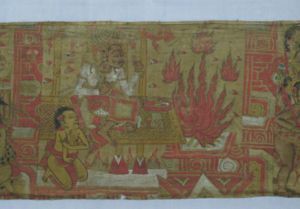
the shrine, Samantapancaka. In scene 5 we see Bagawan Rama Parasu seated in a pavilion above
five pools. He conducts his ritual and converses with two other priests who stand opposite him,
their hands raised in a gesture which indicates they are speaking.
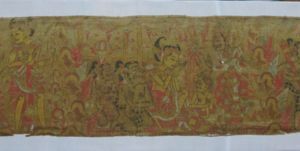
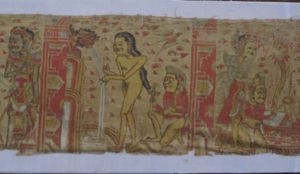
Scenes 6–12 The relationship between priests and kings: alliance
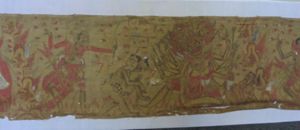
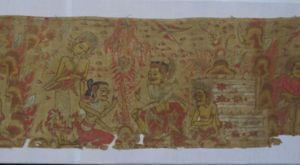
The painting then illustrates scenes of King Janamejaya’s failed ritual. On the left of the following
scene (6) we see King Janamejaya and other nobles in his court. In front of them is Janamejaya’s
brother, Srutasena, who beats the dog Sarameya. The dog is in fact the son of the priests Bagawan
Pulaha and his wife, Sarama. Aware that he is impure, the dog has come to watch the ritual but does
so from a suitable distance. Opposite we see two priests who, as they conduct their ritual in a
2
pavilion, look across the scene watching Srutsena beating the dog. Behind them stands Sarameya’s
mother Sarama, who complains that her son has been unjustly punished. She curses King
Janamejaya’s ritual to failure. In the following scenes King Janameya goes hunting (scene 7). He
comes across two priests, the brothers Bagawan Srutasrawa and Somasrawa. He asked them to
assist him overcome the ill affects of Sarama’s curse so that his ritual might be completed. In the
painting King Janamejaya kneels in front of Bagawan Somasrawa who has become his court priest
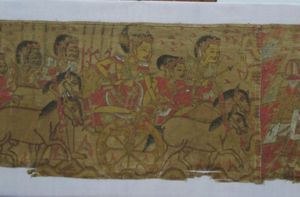
(purohita) (Scene 8). They then make their way back to King Janamejaya’s palace (Scene 9). In
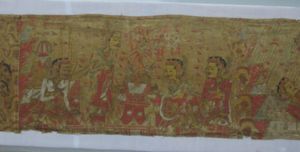
scene 10 Srutasena, who kneels respectfully on the left of the scene, and other court nobles pay
homage to King Janamejaya and his purohita Bagawan Somasrawa on the right. In the following
scene (11) we then see Bagawan Somasrawa conducting a ritual and in the final scene of this
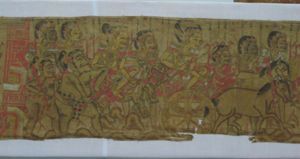
narrative sequence we see King Janamejaya setting out with his army to conquer Taksasila (scene
12).
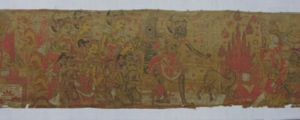
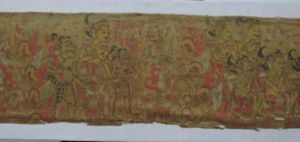
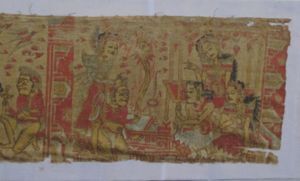
Scenes 13–24 Teachers and their pupils: obedience and its rewards 1
We have come to a point where there is a join in the painting. Here two pieces of cloth have been
carefully sown together. The sequence of scenes which follow illustrate the story of Bagawan
Dhomya and how he tested the obedience of his three pupils, Utamanya, Arunika, and Weda.
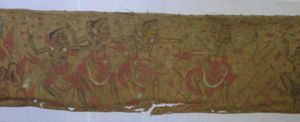
In scene 13 we see Bagawan Dhomya on the left in his hermitage speaking to his three
pupils. Two are seated on the ground in front of Bagawan Dhomya and the third sits behind him and
beside a four-posted pavilion on which there is a dulang with a cover over it. Dhomya sends
Arunika off to work in the rice fields and there he is caught in a severe storm which threatens to
destroy the dykes. To stop the flow of water destroying the rice fields Arunika uses his body to
block it (scene 14). When Bagawan Dhomya sees how obedient his pupil has been he rewards him
with the gift of powerful mantra (Scene 15).
Utamanya is then sent off to herd cattle (scene 16). He works hard and becomes hungry.
However, Bagawan Dhomya tells him that any food he begs belongs to his teacher and must be
given to him. This he does (scenes 17-18). He is also told that he is not to drink the milk of the
cows he herds because it will deprive the calves of the nourishment they require. He is not even
allowed to drink the froth of the milk which the feeding calves leave on the ground behind them
(scenes 19–20). Finally Utamanya is so hungry that he eats a leaf of the Waidura tree and goes blind.
He falls into a dried up well (scene 21) and, when he does not return home, Bagawan Dhomya goes
in search of his student. He finds him and when he discovers what has happened pulls him from the
well (scene 22). He cures his blindness with the aid of a mantra obtained from the Aswin, doctors
to the gods (scene 23). When Utamanya is cured Bagawan Dhomya rewards him with knowledge
which means he will never grow old (scene 24).
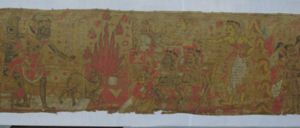
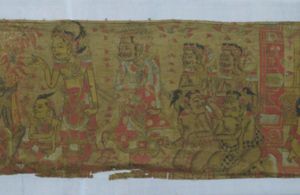
Scene 25–31 Teachers and their pupils: obedience and its rewards 2
The painting passes over the story of Weda’s testing and goes on to illustrate the tale of Weda’s
student Uttangka. Bagawan Weda is determined not to demand payment from his future students
nor to subject them to the examinations which Bagawan Dhomya had subjected him so when
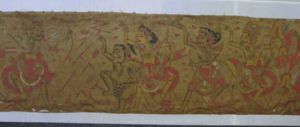
Uttangka arrives he quickly grants him knowledge of the Wedas. In scene 25 we see Uttangka
kneeling in front of Bagawan Weda and his wife. Uttangka wants to present his teacher with
payment for his teaching. However, this request annoys Bagawan Weda and he tells Uttangka to go
and ask his wife what form the payment should take. The wife, who had earlier attempted to seduce
Uttangka while her husband was away attending a ritual in King Janamejaya’s court and whom
Uttangka had rejected out of loyalty to his teacher, angrily demands what she thinks will be an
impossible task. She wants Uttangka to ask King Pausya of Ayodhya for his queen’s beautiful
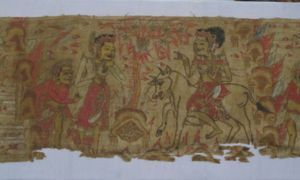
earrings and to return within four days and four nights with them (scene 26). Uttangka wonders how
he will be able to travel so far in such a short time. However on his way he meets a man mounted
on a bull (in fact it is God Indra in disguise riding on his elephant Airawana) who tells him to eat
3
the bull’s feces and drink its urine (scene 27). This he does and his body becomes light and he
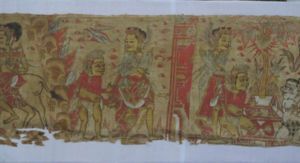
arrives in Ayodhya very quickly (scenes 28). Once there, Uttangka asks King Pausya for his wife’s
earrings (scene 29). King Pausya sends Uttangka to ask his queen Sawitri, However, Uttangka who
is unclean because he ate the bull’s feces and urine cannot find her because she is invisible to
anyone who is impure. King Pausya understands this and instructs Uttangka to bathe in order to
purify himself which he does (scene 30). When he returns he finds the queen, requests the earrings
from her and is given them with a warning that he should beware of the snake Taksaka who desires
the gleaming jewels in the queen’s earrings for himself (scene 31).
This may in fact not be the final scene painted on this cloth. The scene-dividing motif on the
right of the final scene suggests that the cloth might have been damaged or cut at this point with the
consequent loss of further scenes.
|
| Medium of production |
|