| Title of artwork |
|
| Date of work |
|
| Artist(s) |
|
| Locations |
|
| Narrative |
|
| Collected in ... |
|
| Photo credit |
|
| Detail pointer |
|
| Description |
The stories of Bagawan Bregu, Bagawan Puloma and Jaratkaru
|
| Abstracted summary |
A long ider-ider from Pura Bale Batur, Kamasan
|
| Extended description |
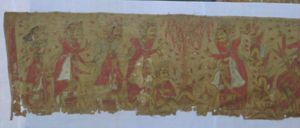
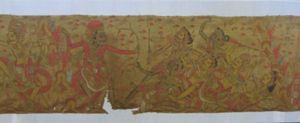
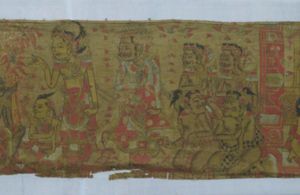
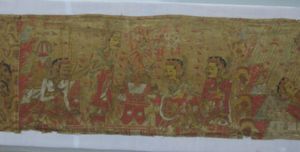
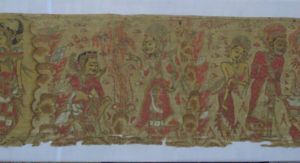
The second ider-ider continues the illustrations of the stories which Bagawan Ugrasrawa tells the priests in the Nemisa Forest. The priest Bagawan Sonika on behalf of his colleagues asks to be told about the origins of their ancestors, the Bargawawangsa. Bagawan Ugrasena begins with the story of Bagawan Bregu and Puloma.
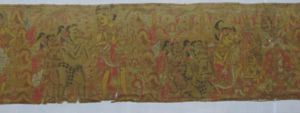
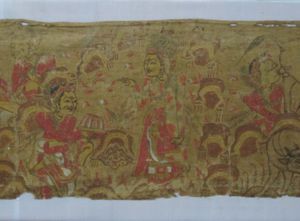
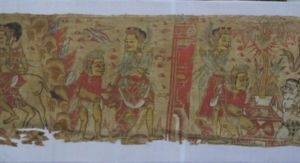
Scenes 1–11 The story of Bagawan Bregu and his wife Puloma: founding a priestly lineage The painting begins with the story of Bagawan Bregu and his wife Puloma. In scene 1 we see Puloma as a baby in her mother’s arms. She sits in a pavilion while the servant on her left holds up a container. Puloma’s mother points towards a black bird (crow) in the tree in front of her. The scene makes reference to the arrangement which Puloma’s father made for his daughter to marry the demon Duloma whom he instructs to take the form of a crow.
Puloma is presented to Bagawan Bregu in the next scene (scene 2) and in the scene which follows (scene 3) Bagawan Bregu and Puloma make their way with their servants to the home of a priest where the marriage rituals take place (scene 4).
In the next scene (5) Bagawan Bregu and Puloma are seen talking to one another. He takes leave of his pregnant wife and in scene 6 we see Bagawan Bregu heading off by himself.
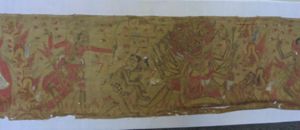
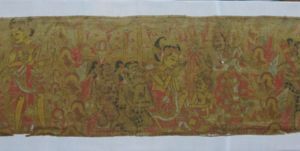
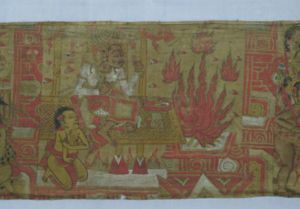
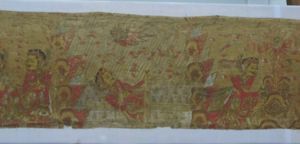
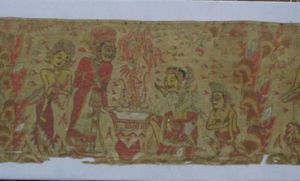
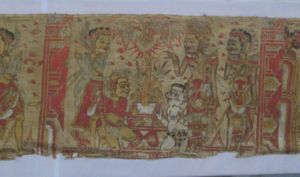
In the following scene (7) the demon Duloma, to whom Puloma’s father has promised her, arrives in Bregu’s hermitage to claim Puloma as his wife. He has summoned God Agni – seen standing to the left of Duloma in the scene – to witness the truth of the claim he makes. God Agni confirms the truth of the claim but points out that the marriage was not properly celebrated, something which had happened when she married Bagawan Bregu. The demon then turns into a wild boar to carry Puloma off. She runs away calling Bagawan Bregu to help her. The baby she bears hears her cries. The child is born prematurely and angrily burns the demon Duloma (scene 8).
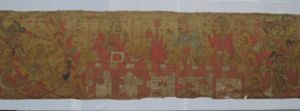
Bagawan Bregu also arrives on the scene, and Puloma, who kneels in front of him, explains what has happened (scene 9).
Bregu is angry with God Agni because of what he has said and he curses him to be the fire which consumes all things (scene 10).
God Agni is now without bodily form and cursed to consume absolutely everything. This throws the gods into turmoil because they can no longer carry out their rituals. In the painting, the four dikpalaka (keepers of the four-quarters) headed by God Indra, kneel on the left of the scene in front of the four-armed God Brahma and on the right we see God Agni with a number of priests. They ask for God Brahma’s assistance. God Brahma agrees that the gods would not be included in those things burnt by God Agni’s fire (scene 11).
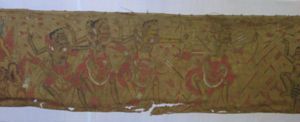
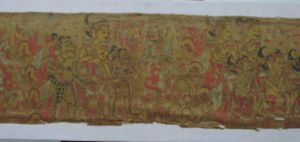
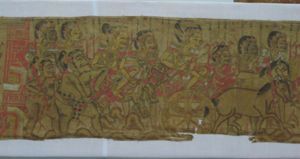
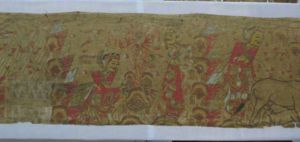
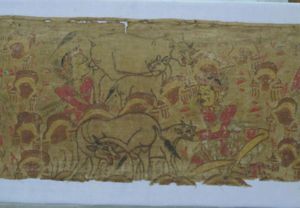
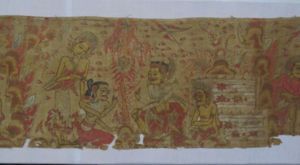
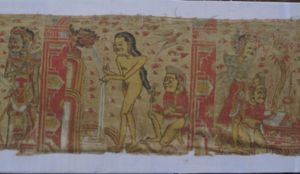
Scene 12-26 The story of Bagawan Ruru and his wife Prathama: the continuation of the priestly house 4 The subject of the following scene (scene 12) is not altogether certain. It is possible that the scene illustrates Bagawan Bregu reunited with his wife, Puloma (now with a ketu) and their child, Cyawana. Perhaps the scene portrays Bagawan Bregu’s son, Bagawan Cyawana and his wife, Sukanya nursing their baby Pamiti. However, it seem most likely that here we see Bagawan Pamiti on the right and his wife Grehaci (she is portrayed with a ketu as in scene 16) and their child, Ruru. In any case in the following scene (scene 13) we see the heavenly nymph Menaka and her partner, the Gandharwa king, Wiswawasu, abandoning their baby daughter on the bank of a river.
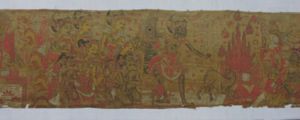
In scenes 14, 15 and 16 the unmarried Bagawan Stulakesa finds the baby girl and takes her home where he brings her up and gives her the name Pramatana.
In scene 17 Ruru kneels respectfully in front of his mother and father requesting that they ask Bagawan Sthulakesa for his approval for him to marry Pramatana.
Scene 18 illustrates the scene in which Bagawan Pamiti asks Bagawan Sthulakesa to agree to the marriage of his son Ruru to Pramatana.
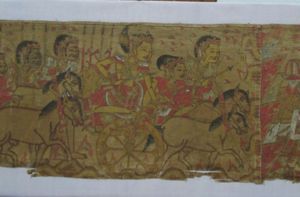
In scenes 19 and 20, we see Bagawan Stulakesa, his daughter Pramatana and a servant traveling to the marriage ceremony where two priests conduct the marriage ritual in the presence of Bagawan Pramiti and his wife, Grehaci.
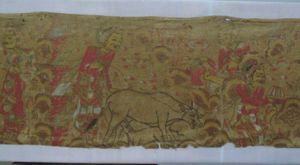
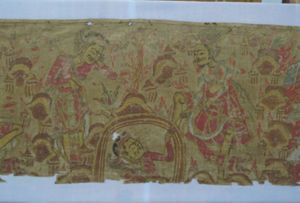
In the next two scenes (21 and 22) the marriage is consummated. The story of Ruru and his wife Pramatana then continues. In the following scene we see them talking to each other (scene 23) and in the following scene (24), as they walk in the garden, she is bitten by a snake who had lain hidden in leaves across their path. In scene 25, Pramatana lies dead on the ground and Ruru grieves over her body. The priest and the gandharwa on the right of this scene are messengers sent from the gods to whom Ruru has appealed to bring his wife back to life again. They tell him that her death has been determined by her former deeds and that if she is to live again Ruru must surrender half his own life and agree not to kill any snakes. A priest must protect the snakes from a king’s punishment as Astika once did when the king Janamejaya conducted his snake sacrifice. Pramatana is revived.
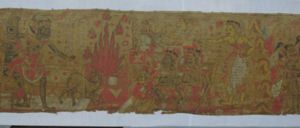
In scene 26 we see her with Ruru and servants walking away. Later their son Sunaka is born. At this point in the Adiparwa, having identified Bagawan Sonaka’s father Bagawan Sunaka, Bagawan Ugrasena finishes his account of the origins of Bregu’s family and at Bagawan Sonika’s request goes to tell the story of Bagawan Jaratkaru.
This conversation is illustrated in scene 27. Scenes 28–34 Bagawan Jaratkaru: a crisis in the continuity of a priestly lineage and a priest’s duty to procreate children to ensure the ongoing performance of rituals for the ancestors.
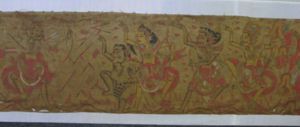
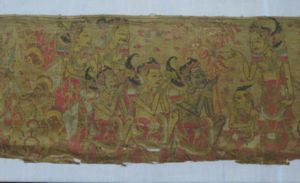
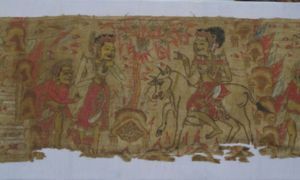
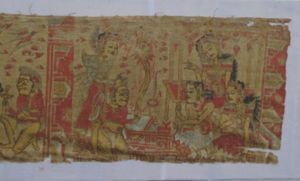
In Scene 28 we see Jaratkaru. Jaratkaru lives the life of a celibate ascetic. In this scene Jaratkaru, armed with power won from his ascetic life, comes across his ancestors while passing through Ayatanastana. He finds them there, suspended upside down from bamboo poles above a deep hole leading to hell. He wants to know why they are there. They tell him it is because he is celibate and because of that their priestly lineage will come to an end and because of that the rituals which they require can no longer be conducted. Jaratkaru agrees to marry and have a child before he once again returns to the life as an acetic. However, he insists on marrying only with a woman who has the same name as his. He goes in search of her and when he cannot find her he calls upon all living things to provide the wife he wants. The serpent, Sang Basuki, who hears Jaratkaru’s request, summons his younger sister Nagini and issues instructions that she be named Jaratkaru. In this way he believes through her marriage with a brahmana the snakes will avoid the fate that awaits them in the snake sacrifice that King Janamejaya plans to perform.
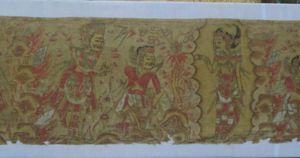
In scene 29 we see the ascetic Jaratkaru on the left in conversation with the Sang Basuki and in the following scene Basuki introduces Jaratkaru to Nagini alias Jaratkaru (scene 30).
Then in the following scene (31) Jaratkaru is seated with his new bride in a pavilion. He has her agree never to say or do anything to make him angry. Should she do so, he will abandon her. One day, once he has seen that she is pregnant, he ask to be left to sleep with his head on her lap (scene 32).
When the time for her husband’s daily prayers at sunset arrives and he remains asleep she wakes him up fearing that if she does not he will be angry with her and leave her. However, when Jaratkaru is awakened he is extremely angry with Nagini 5 because she has disturbed his sleep. She asks forgiveness and reassurance that he will protect her and her family at the time of King Janamejaya’s sacrifice of snakes. Jaratkaru insists that he must leave but assures her that the child she bears, Astika, is her insurance that all will go well at the time of King Janamejaya’s snake sacrifice (scene 33).
Jaratkaru then departs to continue his life as a celibate ascetic (scene 34).
(text Peter Worsley)
|
| Medium of production |
|