| Title of artwork |
|
| Locations |
|
| Narrative |
|
| Collected in ... |
|
| Exhibition Marker | |
| Catalog Number |
|
| Photo credit |
|
| Description |
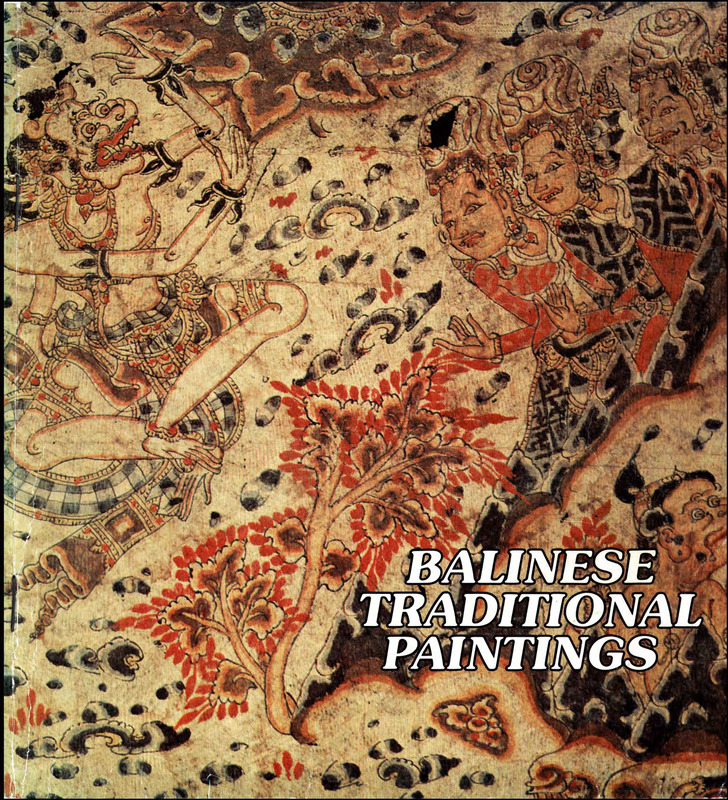
Has text (identifying character bottom right) "Begawan Sumitra", probably Bagawan Wiswamitra, from the Adiparwa
|
| Abstracted summary |
In the Ādiparwa Bagawan Wiśwāmitra (Sumitra) was tempted from his asceticism by the widhyadari Menaka. Menaka had a daughter, Śakuntala, by Sumitra. The daughter was abandoned and brought up by Bagawan Kanwa. She in turn had a casual affair with Mahāraja Duśwanta, and had a son by him. The son was taught knowledge of communication with animals by Kanwa, and called Sarwadamana. The tabing takes up the story at a point where Śakuntala and her son intend to go to Duśwanta to ask him to make Sarwadamana his rightful heir. In the bottom left-hand corner of the painting Kanwa blesses the two before they go to Duśwanta. Above this Śakuntala takes Sarwadamana to Duśwanta, but the Mahāraja, accompanied by Delem and Sangut, angrily rejects the pair, who are accompanied by animals.
However, the gods inform the king that he has not to reject his true son. This is not shown in the painting, but Duśwanta is shown enthusiastically embracing the pair. In the top right hand scene Sarwadamana is shown seated on a raised platform, with his parents behind him. In front sits a long-haired priest, who consecrates Sarwadamana into kingship. Sarwadamana is then called Bharata, the major ancestor of the Pandawa (of Mahābharata, Bharata-yudha). Bharata is the cakrawatin, the world ruler, confirmed by the Purohita. It is difficult, from the literary Ādi, to explain the depiction of Bagawan Sumitra in the paintings lower right-hand corner. The depiction could be explained as an attempt to emphasize the line of descent, to show that Bharata is a Kśatriya whose most powerful immediate ancestors and Bhramana. Such intentions coincide with the belief that the Dèwa Agung and the other Kśatriya Dalem of Bali are of priestly origins. It is interesting to see how in the painting the cakrawatin combines the sakti of Bagawan and Mahāraja.
|
| Medium of production |
|
| Date artwork started |
|
| Date artwork completed |
|
| Height (cm) |
|
| Width (cm) |
|